
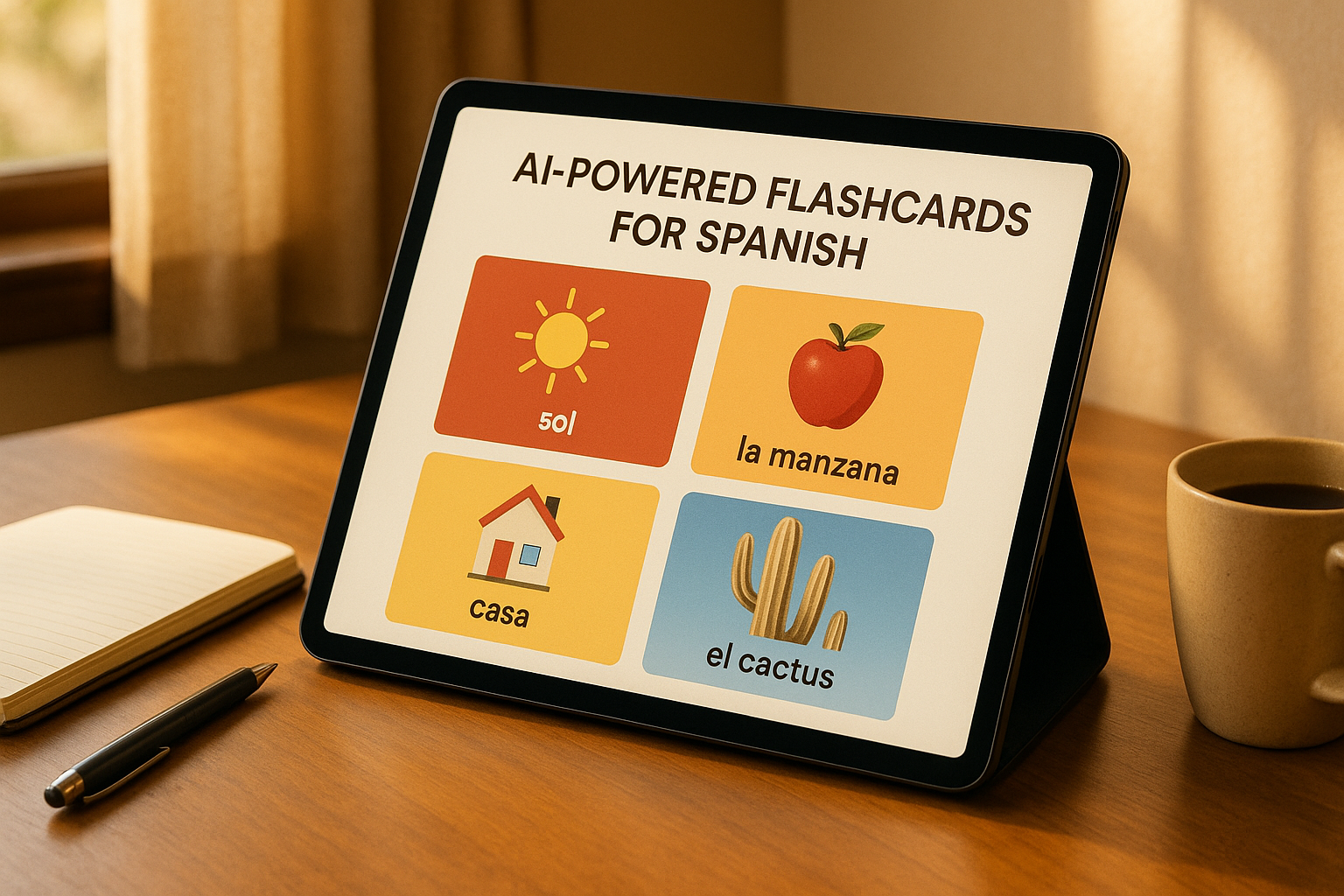
AI-powered flashcards are transforming Spanish vocabulary learning by combining advanced technology with proven memory techniques like spaced repetition and active recall. Here's why they're effective and how they work:
- Tailored Learning: Automatically adjust to your pace, focusing on words you struggle with and reducing review time for mastered ones.
- Spaced Repetition: Schedule reviews at optimal intervals to combat forgetting and boost long-term memory by up to 200%.
- Multimedia Features: Enhance learning with native pronunciation, images, and real-world sentence examples.
- Convenience: Study anytime on your phone, with decks created from textbooks, prompts, or study materials.
Quick Comparison: AI vs. Traditional Flashcards
| Feature | Traditional Flashcards | AI-Powered Flashcards |
|---|---|---|
| Review Scheduling | Fixed intervals | Adjusts based on performance |
| Content Creation | Manual input required | Automated from study materials |
| Multimedia Support | Limited (text/images only) | Audio, images, and examples |
| Learning Efficiency | ~50% | Up to 90% |
| Feedback | None | Instant, detailed explanations |
With AI-powered flashcards, you can learn Spanish vocabulary faster, retain more, and enjoy a personalized, interactive experience.
AI Anki Flashcards and ChatGPT for Language Learners
How AI-Powered Flashcards Work
AI-powered flashcards are reshaping how we learn vocabulary by blending advanced technology with memory science. These tools go beyond traditional methods, offering a learning experience tailored to your needs and study habits.
Spaced Repetition and AI Algorithms
The magic behind these flashcards lies in their use of spaced repetition algorithms. This technique adjusts review intervals based on your performance - correct answers lead to longer intervals, while mistakes prompt more frequent reviews. The goal? To combat the "forgetting curve", a concept introduced by Hermann Ebbinghaus that shows how quickly we forget new information without reinforcement.
Without regular review, up to 80% of new material can slip away within a week. AI-powered systems tackle this head-on. Research indicates that personalized spacing improves retention by 35% compared to fixed review schedules. A 2015 study even found that students who reviewed material eight days after learning it performed better than those who reviewed after just one day.
Dr. Robert Martinez, a Cognitive Neuroscientist at Johns Hopkins University, highlights the impact:
"The integration of AI with established memory science represents one of the most significant advances in learning technology of the past decade. By personalizing the forgetting curve for each student, these systems achieve retention rates that traditional methods simply cannot match."
But spaced repetition is just the beginning. These systems take personalization a step further.
Personalized and Adaptive Learning
AI-powered flashcards don’t just schedule reviews - they adapt to your unique learning journey. By analyzing your performance, the system pinpoints areas where you struggle and generates additional cards to address those gaps. For Spanish learners, this might mean focusing on tricky verb conjugations, gendered nouns, or specific vocabulary themes.
The system also adjusts difficulty in real time. It ensures you're always challenged just enough to stay engaged, without feeling frustrated or bored. This balance keeps you in a productive learning zone.
Another standout feature is flexibility. Whether you learn best through visuals, concise definitions, or scenario-based questions, the AI adapts the format to match your style. Studies confirm that personalized materials lead to more efficient learning. Users often notice tangible improvements, such as higher exam scores - by an average of 15% - and increased motivation due to varied question formats.
Multimedia Integration for Better Engagement
AI-powered flashcards also incorporate multimedia elements to make learning more engaging and effective. By appealing to multiple senses, they cater to different learning styles and help reinforce memory.
For Spanish learners, audio is a game changer. The AI generates native pronunciation examples, helping you master the subtle nuances of Spanish sounds, like rolled R's and distinct vowel tones. Hearing these pronunciations while studying enhances both recognition and speaking skills.
Visual aids take it a step further. Pairing vocabulary with images - for instance, connecting "la cocina" (kitchen) with a photo of a kitchen - creates stronger memory associations than text alone. Contextual examples deepen understanding even more. Instead of just showing a word and its translation, the system might present a full sentence, such as "Me gusta correr en el parque" (I like to run in the park), to demonstrate real-world usage.
These multimedia features also emphasize grammar patterns and cultural nuances, making learning more immersive. Plus, the instant feedback provided by the system helps correct mistakes as they happen, reinforcing accurate answers and preventing misunderstandings.
Benefits of AI-Powered Flashcards for Spanish Vocabulary
AI-powered flashcards bring a new level of efficiency and personalization to learning Spanish vocabulary. By leveraging advanced algorithms and multimedia features, these tools make acquiring new words faster and easier.
Faster Vocabulary Learning
AI-powered flashcards significantly speed up the process of learning Spanish vocabulary. Unlike traditional methods that stick to a rigid curriculum, these tools adjust to your learning pace, offering lessons and feedback tailored just for you.
With real-time feedback and interactive exercises, mistakes are corrected instantly, and proper usage is reinforced. Features like game-style modules make studying more engaging, turning what might feel like a chore into a productive and enjoyable experience. As SPEC INDIA explains:
"AI improves language acquisition by offering adaptive learning paths, instant error correction, and interactive content. It tracks your progress and focuses on areas you struggle with. This targeted approach enhances retention and speeds up learning. Plus, gamification keeps learners motivated and engaged."
Better Memory and Recall
Using the concept of spaced repetition, based on Ebbinghaus's forgetting curve, AI-powered flashcards schedule reviews at just the right intervals to strengthen long-term memory.
The integration of multimedia - like combining the Spanish word gato (cat) with an image and its pronunciation - creates multiple memory triggers, making it easier to recall. Progress tracking systems also encourage consistent learning by showing tangible growth. Studies suggest that learning around 2,000 high-frequency words can help achieve basic conversational skills in Spanish. AI-powered flashcards prioritize these essential words, ensuring you focus on the vocabulary that matters most.
Customizable to Your Needs
One of the standout features of AI-powered flashcards is their adaptability to your specific learning goals and pace. You can adjust the number of flashcards or the length of your sessions, whether you have just 10 minutes or a full hour to study.
These tools also allow you to target specific areas, such as verb conjugations or commonly confused words like ser and estar (both meaning "to be"). If you're struggling with a particular topic, the system generates extra practice cards to help you improve.
Customization goes further by aligning with your learning style. Whether you prefer visual aids, audio repetition, or examples in context, the flashcards adapt to suit your preferences. Plus, with 24/7 accessibility, you can practice anytime, anywhere. Many platforms even include community features for sharing and discussing flashcards with other learners.
The growing popularity of AI in education highlights its impact. Between 2021 and 2027, the market is projected to grow by over 40% annually, with 70% of students favoring online learning over traditional methods. This shift underscores the effectiveness of personalized, adaptive tools like AI-powered flashcards in transforming language learning.
sbb-itb-dfae180
Step-by-Step Guide to Using AI-Powered Flashcards
Getting started with AI-powered flashcards might seem daunting at first, but with the right steps, you can create a system that adapts to your learning style and helps you quickly build your Spanish vocabulary.
Choosing the Right Flashcard App
The first step is picking an app that matches your learning preferences and goals. As Alex Redfern, CEO of LanguaTalk, puts it:
"AI can be used for various aspects of language learning, such as conversation practice, grammar corrections, and vocabulary acquisition."
Consider your budget when choosing an app. Options range from free trials to subscriptions priced between $2.99 and $29 per month.
Look for apps with features that make learning more effective. For example:
- Spaced repetition algorithms: These help you review words at the right intervals to reinforce memory.
- Multimedia tools: Audio pronunciations, images, and interactive quizzes make the process more engaging.
- Progress tracking: This lets you monitor your improvement over time.
If you're focused on Spanish, check out the curated app list on the Spanish Language Learning Apps website (https://spanishlanguagelearningapps.com). It highlights tools like Language Drops for visual learning, Mondly for chatbot interactions and voice recognition, and Ella Verbs for mastering verb conjugations.
Take advantage of free trials to explore interfaces and find the app that feels most intuitive for you. Once you've made your choice, the next step is to customize it for your learning needs.
Setting Up Your Learning Profile
After selecting your app, setting up a personalized learning profile is key. Many apps align with CEFR (Common European Framework of Reference for Languages) levels, ranging from A1 (beginner) to C2 (proficient).
Here’s how to get started:
- Define your goals and assess your level: Use placement tests to determine your starting point and set clear objectives, like "hold basic conversations by December 2025."
- Break goals into smaller steps: For example, if you aim for conversational fluency, focus on vocabulary for specific scenarios like ordering food, asking for directions, or discussing hobbies.
- Set a consistent study schedule: Whether you can spare 10 minutes during a commute or an hour in the evening, consistency is more important than duration. Apps can adjust session lengths based on your availability.
- Tailor the experience to your preferences: If you learn better with visuals, choose image-heavy cards. If audio works best, focus on pronunciation exercises.
With your profile set, you’ll be ready to fully utilize the app’s features to speed up your progress.
Using Features for Better Learning
Unlocking the full potential of your app’s features can turn flashcard practice into a dynamic and efficient learning process.
-
Trust spaced repetition: Follow the app’s review schedule - it’s designed to help you revisit material just before you forget it.
-
Engage with multimedia: When learning a word like perro (dog), listen to its pronunciation, study the image, and review example sentences to strengthen your memory.
-
Add vocabulary on the go: Many apps let you create decks from external resources, saving significant time. Some users report saving two hours for every 10 hours of study thanks to this automation.
-
Track your progress: Set measurable goals, like "learn 50 new food-related words this month" or "achieve 90% accuracy on conjugation cards", and review your stats weekly to identify areas for improvement.
-
Time your sessions: Occasionally challenge yourself with quick-fire reviews to improve recall speed and fluency.
-
Use your downtime: Since most apps are mobile-friendly, even a short wait - like standing in line or sitting on the bus - can become a learning opportunity.
-
Focus on tricky words: If certain words or concepts give you trouble, create additional cards to explore them in different contexts. For example, to practice ser vs. estar, craft multiple sentences that highlight their unique uses.
-
Mix learning methods: Combining flashcards with other tools, like conversational practice or grammar exercises, can create a more balanced learning experience. As Alex Redfern notes:
"The combination of both can lead to a well-rounded and effective Spanish learning experience."
Lastly, keep your app updated. Developers frequently improve features and add content based on user feedback and research, so enabling automatic updates ensures you’re always using the latest tools.
AI-Powered vs Traditional Flashcard Methods
The gap between AI-powered flashcards and traditional paper cards goes far beyond the digital format. While traditional flashcards rely on manual creation and static review schedules, they often fall short in efficiency and adaptability. With paper flashcards, you create each card by hand and review them in a fixed order, treating all vocabulary equally - even after you've mastered some of it.
AI-powered flashcards, on the other hand, adjust dynamically to your learning progress. These systems analyze your performance, pinpoint weak areas, and fine-tune the review process in real time. Unlike paper cards, which are limited to the vocabulary you initially select, AI flashcards continually adapt to your needs. Here's a closer look at how these two methods compare:
Key Differences in Learning Speed
The benefits of AI flashcards become even more apparent when you compare their features and outcomes. Studies show that adaptive learning systems can boost student retention by 32% compared to non-adaptive methods. The following table highlights the most notable differences:
| Feature | Traditional Flashcards | AI-Powered Flashcards |
|---|---|---|
| Review Scheduling | Fixed intervals for all cards | Adjusts scheduling based on individual performance |
| Personalization | Uniform approach for all users | Tailors vocabulary to your proficiency, interests, and goals |
| Content Creation | Requires manual input | Automatically generates decks from study materials |
| Multimedia Support | Limited to text and basic images | Includes images, audio, video, and interactive elements |
| Learning Efficiency | Around 50% efficiency | Up to 90% efficiency in learning |
| Feedback System | No explanations for errors | Provides instant, detailed feedback with explanations |
AI-powered flashcards can deliver up to 90% learning efficiency compared to just 50% with traditional methods. In practical terms, this means you can learn twice as much in the same amount of study time. Additionally, users report saving roughly two hours for every 10 hours of study by automating flashcard creation.
Traditional flashcards also lack the ability to explain why an answer is correct or incorrect. AI systems step in here, offering hints, rephrased questions, and detailed, step-by-step explanations for mistakes. They also optimize review schedules, ensuring challenging words are revisited at the perfect time.
One biochemistry student, for instance, saw a 15% improvement in exam scores after just two weeks of using AI-powered flashcards. Similarly, Spanish learners find that AI flashcards make mastering vocabulary, verb conjugations, and cultural expressions far more efficient and effective.
Why AI-Powered Flashcards Change Spanish Learning
AI-powered flashcards are transforming how people learn Spanish vocabulary. Unlike traditional memorization techniques, these tools create a tailored learning experience that adjusts to your specific learning habits and goals.
Studies back up their effectiveness. For example, spaced repetition can improve long-term memory retention by 200%. Plus, focusing on the top 1,000 most common words allows learners to understand up to 80% of everyday conversations. This means learners can progress faster and stay more engaged.
But there's more to it than just efficiency. AI-powered flashcards also tackle pronunciation and cultural understanding. With AI-driven speech recognition, learners see a 25% improvement in pronunciation accuracy compared to older methods. This doesn’t just refine how words are pronounced - it helps learners grasp cultural subtleties, making vocabulary easier to remember and apply in real-life conversations.
FAQs
AI-powered flashcards take learning Spanish to the next level by combining personalized learning with spaced repetition. These tools adjust based on your progress, zeroing in on the words or phrases that challenge you the most. This targeted approach strengthens your memory and helps you retain vocabulary more effectively.
What sets AI-powered flashcards apart from traditional ones is their ability to offer interactive and dynamic formats. These formats are designed to enhance active recall while reducing memory loss over time. Studies have shown that tailored learning methods can dramatically boost how much you remember, making your study time not just more productive but also more enjoyable.
When choosing an AI-powered flashcard app for learning Spanish, focus on tools that help improve both your understanding and retention. Features like native-speaker audio are invaluable for sharpening your pronunciation, while examples rooted in everyday situations make vocabulary more relevant and easier to remember.
Apps with personalized learning algorithms stand out because they adjust to your progress, zeroing in on areas where you need extra practice. Other helpful features include spaced repetition to reinforce memory, multimedia options like images, audio, and video for a richer learning experience, and progress tracking to keep you motivated and on track.
AI-powered flashcards take Spanish pronunciation to the next level by using speech recognition to evaluate your speech and deliver instant feedback. This helps you fine-tune your accent and improve accuracy. They also go beyond just language basics by including contextual examples and lessons designed for real-life situations, which can help you understand subtle nuances and proper usage. This combination makes learning Spanish not only effective but also engaging and relevant.