
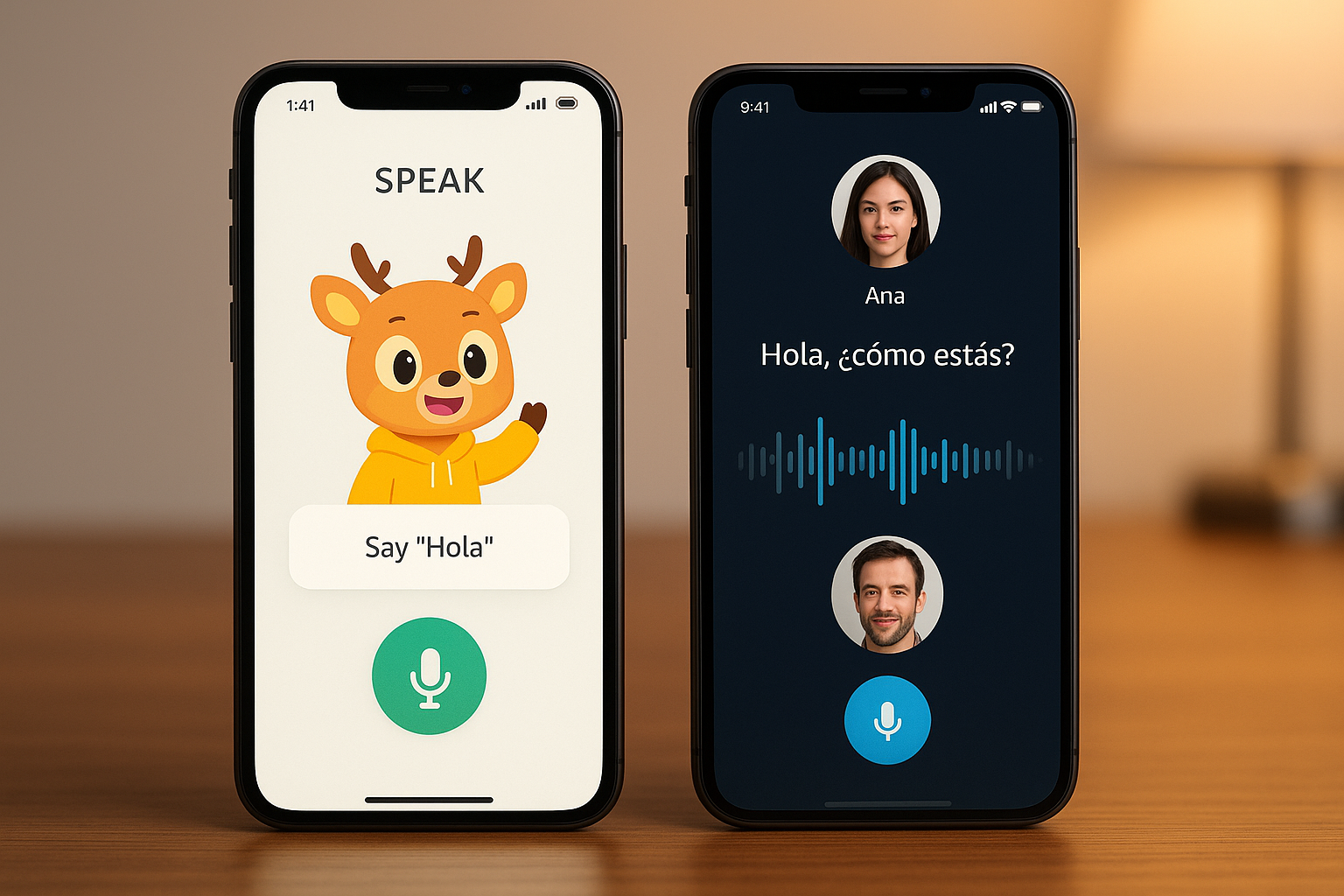
If you're learning Spanish and trying to decide between LingoDeer and Rocket Spanish, here's a quick breakdown of their speaking features:
- LingoDeer: Focuses on structured lessons with grammar explanations, native audio, and basic pronunciation tools. Offers features like storytelling, role-playing, and record-and-compare exercises. Best for beginners who want step-by-step learning.
- Rocket Spanish: Emphasizes practical speaking skills through interactive audio lessons, role-playing, and advanced pronunciation feedback using Google's Web Speech API. Ideal for learners targeting conversational fluency in Latin American Spanish.
Quick Comparison
| Feature | LingoDeer | Rocket Spanish |
|---|---|---|
| Voice Recognition | Basic third-party system | Google Web Speech API with detailed scoring |
| Speaking Practice | Dialogues, storytelling, and role-playing | Interactive audio lessons (75% of content) |
| Pronunciation Feedback | Record-and-compare method | Numerical scoring (1-100) |
| Dialect Focus | General Spanish | Latin American Spanish |
| Price | $11.99/month or $119.99 lifetime | $99.95 (Level 1) to $259.90 (All levels) |
Key Takeaway
Choose LingoDeer for a grammar-focused, beginner-friendly approach. Opt for Rocket Spanish if you want in-depth speaking practice and conversational skills. Both apps cater to different learning styles, so pick based on your goals.
Rocket Spanish Review: The FASTEST Way to Learn Spanish?

How We Compare Speaking Features
We evaluate four main aspects of each app's speaking features to give you a clear picture of what they offer.
Voice Recognition Quality
Accurate voice recognition is the backbone of any language-learning app. Rocket Spanish relies on Google's Web Speech API to evaluate pronunciation, scoring it on a 1-100 scale. This feature provides instant and precise feedback on how well you're pronouncing words.
LingoDeer, on the other hand, uses third-party voice recognition tools. While functional, some users have reported occasional issues with how accurately the app picks up their speech.
Next, let’s dive into how these apps offer speaking practice.
Speaking Practice Options
Rocket Spanish excels with its interactive audio lessons, which make up a whopping 75% of its content. It also includes a unique "Play it!" feature, where you can take on the role of a native speaker in simulated conversations.
LingoDeer incorporates native audio into all its courses, allowing users to record their voice and compare it to native speakers. However, compared to Rocket Spanish, it falls short in providing a more comprehensive speaking practice system.
Pronunciation Feedback System
When it comes to feedback, Rocket Spanish offers detailed scoring powered by Google's speech recognition technology. This system gives learners specific metrics to help pinpoint areas for improvement.
By contrast, LingoDeer uses a simpler method. Its record-and-compare feature enables learners to self-assess their pronunciation by listening to native examples and their own recordings. While effective for basic practice, it doesn’t match the depth of feedback provided by Rocket Spanish.
Practical Speaking Skills
For real-world conversations, Rocket Spanish shines with its "Survival Kit Phrases" feature. This tool equips learners with region-specific vocabulary and pronunciation tailored to Latin American Spanish, making it especially helpful for practical use.
LingoDeer takes a more structured approach to speaking skills but leans less on conversational practice. Language experts often recommend pairing LingoDeer with other resources to strengthen speaking abilities.
| Feature | Rocket Spanish | LingoDeer |
|---|---|---|
| Voice Recognition | Google Web Speech API with 1-100 scoring | Third-party recognition system |
| Speaking Practice Format | Interactive audio lessons (75% of content) | Record and compare method |
| Conversation Practice | Role-play dialogues | Limited dialogue options |
| Pronunciation Feedback | Detailed numerical scoring | Basic audio comparison |
LingoDeer Speaking Features

Practice Dialogues
LingoDeer offers three main components to boost speaking skills: Story-Speaking, Travel Phrasebook, and the premium "Fluent" feature. The "Fluent" section combines audio lessons with speaking and writing exercises tailored for Spanish conversations. Each dialogue includes "Key Points" that summarize essential grammar rules and provide useful sample sentences. While free users can explore a limited number of "Fluent" topics, most of the content is available only with a premium subscription.
What sets LingoDeer apart is its storytelling approach, where learners take on roles in real-life scenarios like ordering food or asking for directions in Spanish. This immersive method keeps practice engaging and relatable.
In addition to these dialogues, LingoDeer incorporates advanced tools to help learners refine their spoken Spanish.
Speech Training Tools
Once learners dive into interactive dialogues, LingoDeer enhances the experience with specialized speech training tools. These tools assess:
- Pronunciation accuracy
- Accent quality
- Overall fluency
The app records your speech, analyzes it against native speaker samples using advanced algorithms, and delivers instant feedback. To make learning more adaptable, users can adjust audio playback speed during lessons. Some courses even offer alternative voice options, providing exposure to various Spanish accents.
Practice Methods
To further build conversational confidence, LingoDeer provides a variety of practice methods. Here's how they work:
| Practice Type | Description | Benefit |
|---|---|---|
| Story Recitation | Record storylines line by line | Strengthens confidence in extended speech patterns |
| Role-Playing | Engage in interactive real-life scenarios | Develops practical conversational skills |
| Pronunciation Drills | Focus on individual sounds and words | Enhances accent and clarity |
All reading materials feature real human voices, ensuring learners hear authentic pronunciation models throughout their practice.
Rocket Spanish Speaking Features
Rocket Spanish offers tools designed to help users improve their pronunciation and speaking skills. Using advanced voice recognition technology, the program focuses on building practical, real-world speaking proficiency, much like LingoDeer.
Conversation Practice
Rocket Spanish's speaking exercises are built around 20-minute audio lessons that mimic real-life scenarios. These lessons start with simple situations, such as ordering coffee, and gradually progress to more complex conversations.
Through role-playing exercises, users can practice speaking and receive real-time feedback on their pronunciation. This repetition helps build confidence while introducing learners to regional variations in Spanish, making the experience both practical and immersive.
Dialect Options
The program focuses on Latin American Spanish, equipping learners with conversational skills that match everyday use. Here’s how Rocket Spanish supports this:
| Feature | Description | Benefit |
|---|---|---|
| Voice Comparison | 2,666 phrases with native audio | Helps users refine pronunciation |
| Difficulty Levels | Three-tiered voice recognition system | Gradual improvement of accents |
| Regional Variations | Emphasis on Latin American Spanish | Prepares learners for authentic dialogue |
Progress Measurement
Rocket Spanish complements its interactive lessons with tools to track and measure speaking improvements:
- Pronunciation Scoring: Rates pronunciation on a scale of 1–100 for each speaking exercise.
- Visual Feedback: Uses a color-coded system - green, yellow, and red - to highlight pronunciation accuracy.
- Syllable Analysis: Pinpoints specific syllable-level pronunciation errors, guiding users to make precise corrections.
"The Rocket program has filled the gap and the reinforcement exercises have helped tremendously!!" - Leo DesBiens, Rocket Spanish User
With a 4.7-star rating based on over 5,000 user reviews, Rocket Spanish is highly praised for its audio lessons and the accuracy of its voice recognition technology. These features make it a standout choice for learners aiming to develop confident and authentic speaking skills.
sbb-itb-dfae180
Direct Feature Comparison
This section dives into the key speaking features of LingoDeer and Rocket Spanish, highlighting their strengths and areas where they differ.
Feature Comparison Table
| Feature | LingoDeer | Rocket Spanish |
|---|---|---|
| Voice Recognition | Third-party speech recognition | Google Web Speech API |
| Pronunciation Scoring | Basic feedback system | Numerical scoring (1-100) |
| Speaking Format | Dialogues and stories | Interactive audio lessons |
| Conversation Practice | "Fluent" feature focus | Role-playing scenarios |
| Audio Content | Dialogue prompts | 75% interactive audio lessons |
| Dialect Focus | General Spanish | Latin American Spanish |
The table provides a snapshot of the core differences. Let’s break down the strengths and challenges of each app.
App Advantages and Limitations
LingoDeer Strengths:
- Offers a variety of practice formats, including dialogues and stories.
- Beginner-friendly, creating a welcoming learning environment.
- Provides structured progression for conversational skills.
- Includes the "Fluent" feature, which emphasizes conversation practice.
LingoDeer Limitations:
- Speech recognition accuracy is inconsistent, which may frustrate learners.
- Advanced conversation options are somewhat limited compared to other platforms.
- Feature availability can differ depending on the language being studied.
Rocket Spanish Strengths:
- Focuses heavily on audio-based learning, ideal for auditory learners.
- Uses a precise numerical scoring system for pronunciation feedback (1-100).
- Offers practical conversation scenarios that mimic real-life interactions.
- Includes interactive speaking drills to reinforce verbal skills.
Rocket Spanish Limitations:
- Voice recognition struggles with longer phrases, limiting its effectiveness.
- Concentrates exclusively on Latin American Spanish, which might not suit learners aiming for European Spanish.
"Compared to other voice recognition software I've tested (including Rosetta Stone), the Rocket/Google combo is definitely one of the best." - Debbie Lopez, Test Prep Insight
While both apps provide tools to improve speaking skills, speech recognition technology remains a common hurdle. These differences highlight the importance of choosing the app that best aligns with your learning style and goals. Whether you prioritize diverse practice formats or precise pronunciation feedback, the decision ultimately depends on personal preference.
Picking the Best App for You
After reviewing the main speaking features, here’s how to decide which app aligns with your learning goals.
Decision Points
| Learning Priority | LingoDeer | Rocket Spanish |
|---|---|---|
| Learning Style | Interactive lessons with varied formats | Structured, audio-based learning |
| Speaking Focus | Real-life scenarios and dialogues | Interactive audio lessons |
| Price Point | $11.99/month to $119.99 lifetime | $99.95 (Level 1) to $259.90 (All levels) |
| Dialect | General Spanish | Latin American Spanish |
| Progression | Beginner to intermediate | Beginner through advanced |
The table above outlines the key differences. Now, let’s explore which app works best in different scenarios.
When to Choose LingoDeer
LingoDeer is a great choice for beginners who want to build a solid foundation in Spanish pronunciation and conversational skills. With over 20 million users and a 4.8-star rating from more than 250,000 reviews, it’s well-suited for those who:
- Are just starting and need help with the Spanish alphabet and pronunciation.
- Enjoy interactive lessons with a variety of formats.
- Want subscription flexibility, including monthly and lifetime options.
- Appreciate clear and detailed grammar explanations.
When to Choose Rocket Spanish
Rocket Spanish, boasting a 4.7-star rating from over 5,000 reviews, is perfect for learners looking for a structured approach. It’s ideal for those who:
- Prefer comprehensive speaking practice through audio-focused lessons.
- Value a clear and guided progression path.
- Are focused on learning Latin American Spanish.
- Need content that covers beginner to advanced levels.
Think about your goals, budget, and preferred learning method to decide which app suits you best. Whether you’re after interactive lessons or structured audio practice, there’s an option tailored to your needs.
Conclusion
Both apps bring different strengths to the table when it comes to improving Spanish speaking skills. LingoDeer stands out with its native audio and detailed grammar explanations, offering a structured path to language learning. On the other hand, Rocket Spanish focuses on interactive audio lessons and uses Google's web speech API to provide detailed pronunciation feedback.
The main difference lies in how they teach. LingoDeer builds a strong foundation with structured lessons and systematic pronunciation exercises. Meanwhile, Rocket Spanish leans into practical conversation skills, using immersive audio lessons to help learners develop speaking confidence more quickly. This contrast makes it easier to decide which app aligns with your learning style.
If you're a beginner looking to master the basics through a structured, grammar-focused approach, LingoDeer might be the better choice. However, if your goal is to quickly improve conversational skills with real-world practice, Rocket Spanish could be the way to go. Both apps have helped countless learners achieve their goals by tailoring their methods to different learning preferences.
FAQs
LingoDeer includes basic speech recognition features, but these can occasionally be inconsistent. This inconsistency may make it challenging for learners to get precise feedback on their pronunciation, potentially slowing down their progress in developing speaking skills.
In contrast, Rocket Spanish employs more advanced speech recognition technology. While it might occasionally have difficulty with shorter words, it typically delivers more reliable feedback. This can help learners refine their pronunciation more effectively and build greater confidence in their speaking abilities.
Rocket Spanish is a great resource for anyone aiming to improve their conversational skills in Latin American Spanish. The program features interactive audio lessons that focus on listening and speaking, giving you plenty of opportunities to practice real-life conversations. Plus, its voice recognition technology helps you fine-tune your pronunciation, so you can speak with more confidence and sound natural.
What sets Rocket Spanish apart is its inclusion of cultural insights, which help you understand the context behind common phrases and expressions. This makes it easier to see how the language is used in everyday scenarios. The course is organized into structured modules that cater to all skill levels, whether you're just starting out or looking to take your Spanish to the next level. With a focus on practical vocabulary and essential phrases, it’s a solid choice for mastering everyday communication.
LingoDeer brings Spanish learning to life with its storytelling and role-playing features, making it an engaging choice for beginners. The role-playing exercises let learners dive into simulated real-life conversations, helping them build speaking confidence while naturally reinforcing grammar and vocabulary.
Meanwhile, the storytelling aspect weaves lessons into a narrative, creating an immersive experience that’s both enjoyable and easier to remember. This approach keeps learners motivated and helps solidify their language skills. Together, these tools offer a fun and practical way to start building Spanish-speaking proficiency.