
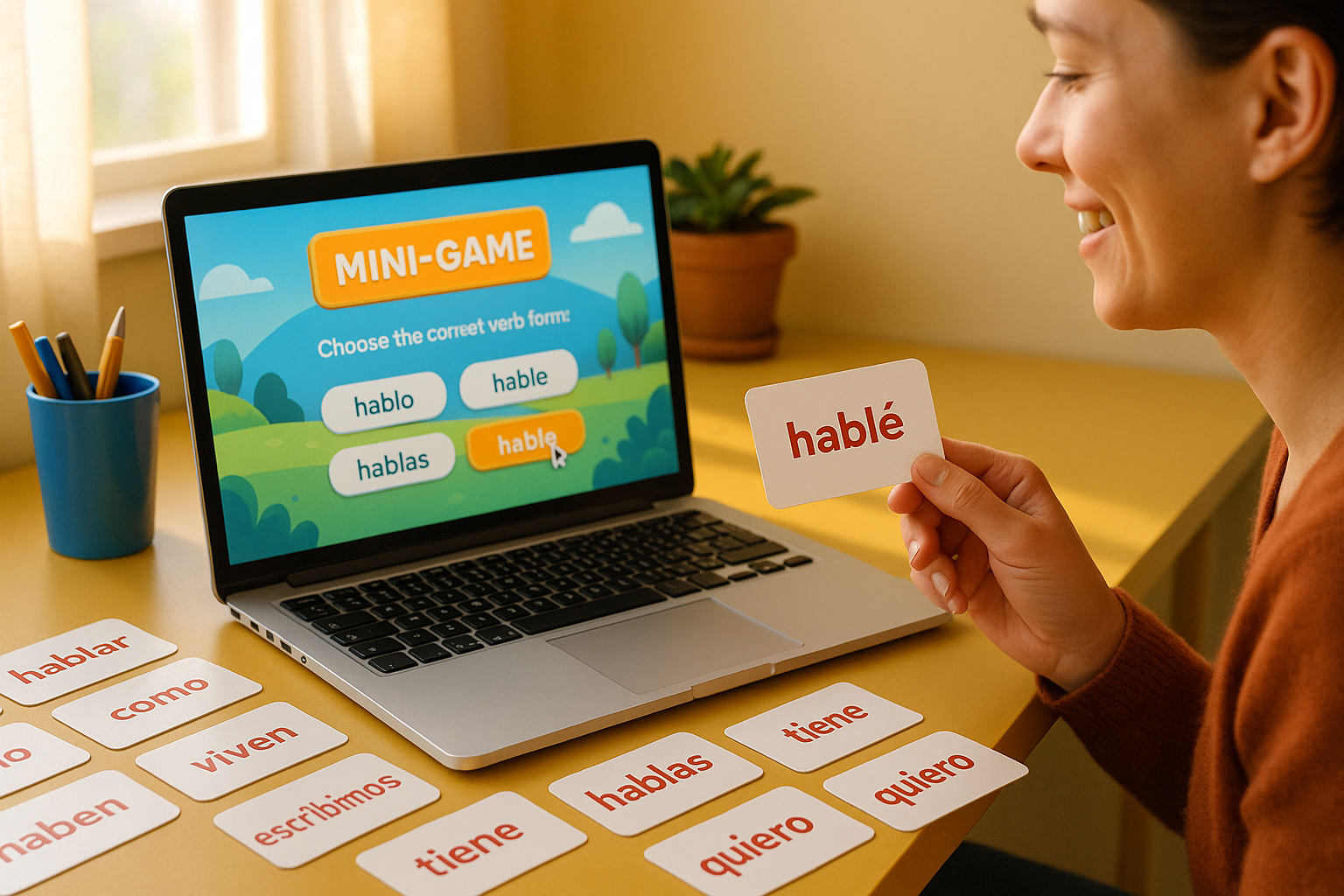
Learning Spanish verb conjugation doesn’t have to be tedious. Mini-games offer a fun, engaging way to practice and improve. Here's why they work:
- Gamified Learning: They turn repetitive drills into enjoyable challenges, keeping you motivated.
- Quick Feedback: Immediate corrections help you learn from mistakes on the spot.
- Real-Life Skills: Fast decision-making in games mimics real conversations, building fluency.
Offline options like Conjugation Chart Races, Maze Printables, and Charades add variety, while apps like ConjuGato, Conjuu, and Ella Verbs provide tailored digital practice. Whether you’re racing the clock, solving puzzles, or using spaced repetition, these tools make mastering Spanish verbs feel less like work and more like play. Ready to make conjugation practice enjoyable? Let’s dive in!
Spanish Verb Sudoku: Practice Conjugations the Fun Way!
Popular Mini-Games for Spanish Verb Conjugation Practice
Offline mini-games offer a fun and hands-on way to practice Spanish verb conjugations. With just a few basic materials and a little imagination, these games combine the repetition needed for learning with interactive play that keeps things interesting.
Conjugation Chart Races and Maze Printables
Conjugation chart races turn the often monotonous task of filling out verb tables into an exciting competition. Here’s how it works: grab a blank verb chart (like the free PDF available from SrtaSpanish.com for newsletter subscribers) and race against the clock to complete it correctly.
For beginners, start with simple regular -ar verbs. If you’re more advanced, try tackling trickier distinctions like preterite versus imperfect or even subjunctive forms. The challenge lies in conjugating a verb for all six persons in a specific tense before time runs out. It’s a great way to quickly identify where you might need more practice.
Maze printables add a creative twist by combining conjugation practice with problem-solving. SrtaSpanish.com offers printable mazes where students navigate by choosing the correct verb conjugation. Imagine reaching a fork in the maze and deciding between "comí", "comía", and "comeré." A wrong turn could lead to a dead end, encouraging you to revisit and correct your mistakes.
For a more active learning experience, try games that involve movement or unexpected elements.
Charades and Dice Games for Verb Practice
Charades brings a physical element to learning verbs. Create a list of verbs paired with actions, and let students act them out while others guess the verb and its correct conjugation. For example, someone might draw a card that says "correr – tú – presente" and act out running, while others guess the conjugated form "corres." This approach not only helps with memorization but also reinforces verb meanings through movement.
Roll a Die & Conjugate games introduce an element of surprise. In these games, players roll a die to determine a subject pronoun and then conjugate a given verb accordingly. A popular variation, the Mi Lápiz Game, uses a die, a pencil, a partner or small group, and a worksheet listing pronouns and verbs. Rolling a less familiar pronoun like "vosotros" can test your knowledge and prepare you for real-life conversational surprises.
Bingo for Regular and Irregular Verbs
Bingo is a classic game that works surprisingly well for verb conjugation practice. Create bingo cards filled with various conjugated verbs, and call out clues like "ser-presente-primera persona singular". Players then look for "soy" on their cards.
This game is easily customizable for different skill levels. Beginners can focus on present tense regular verbs, using conjugations like "yo hablo", "tú comes", and "él vive." The teacher calls out the infinitive form (e.g., "hablar", "comer", "vivir"), and students match it to the correct conjugated form. As students advance, you can mix in irregular verbs and additional tenses to keep things challenging. Bingo not only strengthens verb conjugation skills but also hones listening abilities.
These traditional mini-games serve as a great foundation for verb mastery and transition seamlessly into digital versions for app-based learning.
App-Based Mini-Games for Spanish Verb Conjugation
Digital mini-games have transformed the way we practice Spanish verb conjugation, blending the fun of gaming with the precision of modern learning tools.
Overview of Spanish Language Learning Apps
Several apps have turned the often-daunting task of verb conjugation into an engaging and interactive experience. ConjuGato, for instance, is a dedicated app boasting over 100,000 downloads and a 4.7-star rating on Google Play. It uses a spaced repetition algorithm paired with mnemonic flashcards to help learners tackle even the trickiest irregular verbs.
On the other hand, Conjuu focuses on short, manageable tests that help users refine their spelling of various verb tenses. With a 4.6-star rating on the App Store, it’s perfect for busy learners. As one user, Kmerandi, shared:
"I can use this app anywhere (e.g., waiting for my spinning class to start, my doctors appts, waiting for a table in a restaurant, etc.). Now instead of playing solitaire, I can use this app and do something productive with this waiting time."
Conjuguemos is another standout, widely adopted in educational settings. It supports over 32,000 schools and 4.2 million students, offering a variety of verb-focused games that align seamlessly with popular textbooks. This makes it especially useful for classroom learning.
For those seeking comprehensive practice, Ella Verbs delivers an extensive database of over 2,300 verbs spread across 16 tenses. Its more than 30 progressive levels include built-in quizzes, making it a powerful tool for learners aiming for complete mastery.
With these apps as a foundation, the next section explores how interactive features elevate the learning experience even further.
Interactive Features of Digital Mini-Games
One of the biggest advantages of app-based mini-games is the immediate feedback they provide. For example, if you incorrectly conjugate "tener" in the second person singular, apps like Conjuu instantly correct you, offering explanations to prevent the mistake from becoming a habit.
These apps also track your progress, recording errors, time spent, and accuracy. This data highlights patterns - like consistent trouble with subjunctive forms or stem-changing verbs - so you can focus on your weak spots.
Adaptive difficulty is another game-changer. As you master regular verbs in the present tense, the app gradually introduces more challenging forms, such as irregular verbs or past tenses. ConjuGato’s advanced spaced repetition algorithm ensures that verbs you struggle with are revisited at just the right intervals for long-term retention.
Customizable practice sessions let you target specific areas, whether it’s distinguishing between the preterite and imperfect tenses or improving your grasp of the subjunctive mood.
App Feature Comparison for Verb Practice
| App | Key Strength | Price Model | Best For |
|---|---|---|---|
| ConjuGato | Spaced repetition | Free (250 verbs) + $9.99 upgrade | Long-term retention and irregular verbs |
| Conjuu | Bite-sized tests | Free (basic tenses) + upgrade | Quick practice and spelling accuracy |
| Conjuguemos | School integration | Institutional pricing | Classroom learning and textbook alignment |
| Ella Verbs | Comprehensive database | Varies | Mastery across all tenses |
Each app offers unique strengths, ensuring learners can find one that suits their specific needs and goals.
User interface design is another factor that sets these apps apart. ConjuGato, for example, is praised for its clean and customizable layout. A recent update in May 2025 (version 2.48) introduced a feature to hide outdated tenses, showing the developers’ focus on improving user experience.
Offline functionality is also a valuable feature. Many apps allow you to download verb databases, so you can practice anywhere, even without an internet connection. Some apps even include voice recognition for pronunciation practice, though this feature is still evolving.
sbb-itb-dfae180
How to Add Mini-Games to Your Study Routine
Adding offline games to your study routine can take your Spanish verb practice to the next level. As Ashley Mikkelsen from Srta Spanish explains:
"Spanish verb conjugation games work best when they feel like play, not review."
This perspective shifts how you approach learning. Instead of treating games as a break from studying, they become part of your language-learning toolkit. By blending games with traditional study methods, you create a more dynamic and engaging way to strengthen your skills.
Combining Mini-Games with Standard Learning Methods
Pairing mini-games with traditional study techniques can improve both engagement and retention. Studies suggest that interactive multimedia boosts learner engagement by up to 50%, while shorter, focused learning sessions (microlearning) increase retention by 20% compared to longer study periods.
Start your study session with 10–15 minutes of a game-based warm-up, like an interactive conjugation game, to activate your memory. Then, dive into textbook exercises or grammar practice. Afterward, return to games to reinforce what you’ve learned. For instance, if you’ve just studied the subjunctive mood, play a conjugation chart race or a dice game to practice using it. This back-and-forth method - learning through explanation, followed by playful reinforcement - solidifies your understanding.
To take it further, write short paragraphs using the verbs you practiced in the games. This helps bridge the gap between recognizing verb forms and actively using them. When you come across new verbs in reading materials, add them to your game rotation. Create custom bingo cards or flashcards to connect your reading practice with your gaming.
Scheduling and Tracking Progress
Devote 15–20 minutes daily to mini-games, focusing on a different verb tense each week to stay fresh and avoid burnout. As Mikkelsen advises, "Rotate mini-games weekly to maintain engagement".
Use tools like Conjuguemos to track your progress. These apps often include analytics to highlight your strengths and areas for improvement. You can also keep a simple log of the verb tenses you practice and your accuracy rates. Set clear goals, such as “complete three rounds of irregular verb bingo with 80% accuracy” or “finish a present-tense conjugation chart race in under five minutes.”
Matching Games to Learning Styles
Once you’ve set a schedule and started tracking progress, choose game formats that match your learning style. For example:
- Visual learners: Conjugation charts and maze games help them absorb information more effectively.
- Kinesthetic learners: Activities like dice games or charades keep them engaged through movement.
- Auditory learners: Recording themselves conjugating verbs and listening back can improve pronunciation. Pair this with verbal games like calling out answers during bingo.
- Competitive learners: Timed challenges or racing through conjugation tables can keep them motivated.
- Collaborative learners: Remix traditional games with social elements, like joining online study groups or turning conjugation drills into group competitions.
- Analytical learners: Apps like Ella Verbs, which offer structured levels and detailed feedback, cater to those who prefer clear progression systems.
Mikkelsen emphasizes the importance of keeping games fun and low-pressure:
"The goal is to keep things light, fun, and low pressure while giving your students lots of chances to master verb forms".
If a game starts to feel like a chore, it’s time to switch things up. Adjust the difficulty, try a new format, or explore an entirely different activity. Mini-games should complement your broader study efforts, keeping you motivated and making verb conjugation feel less like a task and more like an engaging part of your routine.
Customizing Mini-Games for US Learners
Bringing mini-games into learning routines for American students means tailoring the content to fit local norms and expectations. By aligning the games with US language, cultural elements, and technical preferences, they become more engaging and effective for learners.
Localizing Content for American Learners
Localization ensures that mini-games resonate with American learners by incorporating familiar contexts and references. For example, when teaching the verb "comprar", you might frame it as shopping at a well-known store like Target. Using everyday scenarios makes practice feel more relatable and meaningful.
Cultural elements also play a big role. When designing games like charades to practice verbs, include actions that are easily recognized by US learners. Instead of "jugar fútbol" (to play soccer), opt for "jugar béisbol" (to play baseball), as baseball holds a more prominent place in American culture.
Additionally, game instructions should stick to American English spelling conventions, such as "color", "organize", and "center." This ensures consistency and minimizes distractions, allowing learners to focus on mastering Spanish conjugations.
Now let’s look at how these games can be made accessible to a broader range of learners.
Making Games Accessible to All Learners
Mini-games can break down traditional learning barriers, offering an inclusive experience for students with different needs. Applying Universal Design for Learning (UDL) principles ensures these games can accommodate a wide range of abilities.
For example, offering multiple difficulty levels allows learners to choose what matches their current skills. Beginners might play a simplified version of conjugation bingo that focuses on regular present-tense verbs, while advanced players tackle challenges involving the subjunctive mood or irregular verbs. Adding visual aids, like color-coded verb endings (blue for -ar, green for -er, red for -ir), and audio pronunciation guides makes the material more accessible, especially for students with sensory disabilities.
Digital mini-games should also be compatible with screen readers and include features like text-to-speech and speech-to-text. Many platforms now provide options such as high-contrast modes, read-aloud functionality, and large, easy-to-read fonts to reduce cognitive strain. Customizable controls, such as remapping keys or adjusting response time, and progress tracking with personalized feedback further enhance the learning experience.
Finally, adapting formats to US standards ensures clarity and ease of use.
Using US Formats for Dates and Measurements
Adapting to US conventions for dates, measurements, and numbers is a small but important step in localization. For example:
- Dates: Use the Month/Day/Year format (e.g., "12/25/2023").
- Measurements: Stick to the US customary system, such as "I walked 3 miles" or temperatures like "Hace 75°F hoy."
- Numbers: Write numbers with commas as thousand separators and periods for decimals (e.g., "1,500 people").
- Time: Use the 12-hour clock with AM/PM indicators, like "Desayuno a las 8:00 AM."
These adjustments may seem minor, but they eliminate unnecessary distractions. Learners won’t need to mentally convert formats, allowing them to focus entirely on mastering Spanish verbs. By aligning with familiar standards, mini-games can deliver a smoother, more effective learning experience.
Making Spanish Verb Conjugation Fun and Effective
Mastering Spanish verb conjugations can feel like a daunting task - after all, with 14 verb tenses and around 84 forms for each verb, there’s a lot to keep track of. But mini-games can turn this challenge into an enjoyable and memorable experience. This playful approach not only makes learning more engaging but also helps improve recall, whether you’re practicing or having real-life conversations.
The magic of game-based learning lies in its ability to keep students actively involved. Games make the process meaningful and interactive, requiring learners to think quickly - a skill that’s just as useful during tests as it is in everyday conversations. Unlike rote memorization, games help solidify the connection between verb conjugations and their meanings.
What’s more, mini-games often foster collaboration, turning group settings into opportunities for active participation. Both digital and offline games come with their own perks. Digital platforms offer tools like customizable quizzes, speech recognition, and tailored learning paths. Meanwhile, offline games can be easily adapted to different learning styles and encourage face-to-face interaction, making them great for social learners.
To keep things fresh and engaging, try switching up your games regularly. Varying time limits and formats can maintain interest and prevent monotony. Plus, games create a low-pressure environment where mistakes are part of the learning process, helping to reduce anxiety and build confidence.
Whether you’re using digital tools like those offered by Spanish Language Learning Apps (https://spanishlanguagelearningapps.com) or creating your own offline activities, incorporating games into your study routine can make a world of difference. By adding movement, collaboration, and a sense of play, those 84 verb forms start to feel less like a chore and more like an exciting challenge you’ll actually enjoy tackling.
FAQs
Mini-games offer a playful and engaging way to sharpen your Spanish verb conjugation skills. Try classics like Bingo, Tic-Tac-Toe, or even dice-based challenges where you conjugate verbs based on the roll. Dedicate short, consistent sessions to these activities, blending fun with effective learning.
For a more tech-savvy approach, check out apps or online platforms that turn conjugation practice into a game. These tools are designed to keep you hooked while tackling those tricky verb forms. By mixing these mini-games into your study routine, you'll make practice something you actually look forward to!
When selecting an app for Spanish verb conjugation practice, prioritize features that make the learning process engaging and productive. Seek out apps with interactive mini-games designed to test your memory and focus, along with detailed conjugation lists that cover a variety of tenses. Tools like speech synthesis can be especially helpful for refining pronunciation. Additionally, apps offering progress tracking and customizable quizzes allow you to monitor your growth and concentrate on areas that need extra attention.
Mini-games can be tailored to suit different learning styles, making Spanish verb conjugation practice more engaging and accessible. For visual learners, activities like colorful charts or flashcards can help highlight and reinforce verb patterns. Kinesthetic learners might prefer interactive options like dice games or physically matching verbs with their correct conjugations. Auditory learners could benefit from games that involve listening and repeating, such as identifying correct conjugations through sound-based challenges. Meanwhile, social learners often thrive in team-based games or group activities where collaboration and interaction are key.
By incorporating these diverse methods, mini-games can transform conjugation practice into a fun and effective learning experience for everyone.