
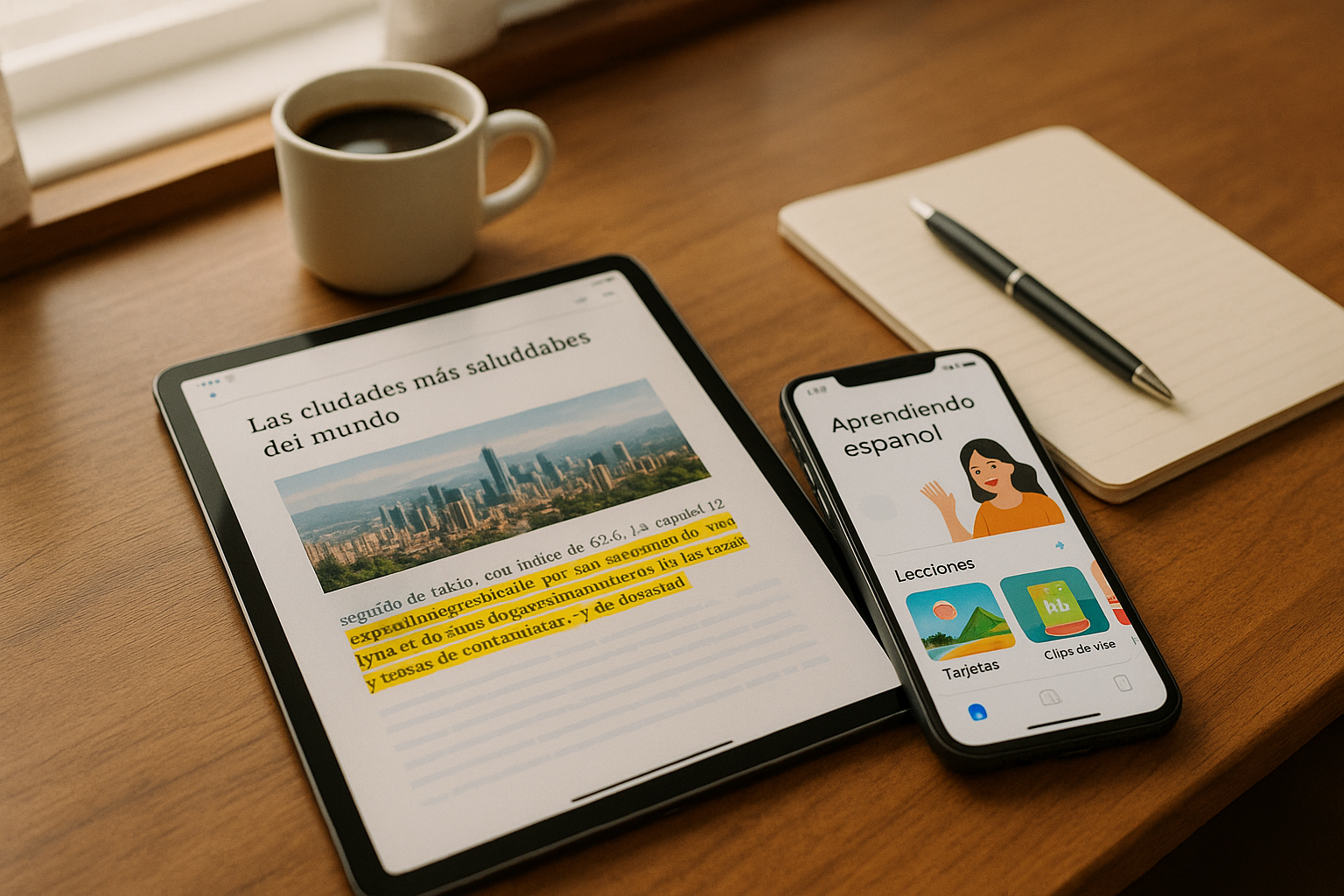
Looking to improve your Spanish reading skills? Here's a quick breakdown of two popular apps, Newsdle and FluentU, to help you decide which one fits your learning style:
- Newsdle: Focuses on daily news articles in Spanish. Offers 3 lessons every day, a one-click dictionary, grammar tools, and audio recordings. Perfect for staying updated and improving reading comprehension. Costs $10/month.
- FluentU: Uses videos like music clips, movie trailers, and talks. Includes interactive subtitles, vocabulary quizzes, and progress tracking. Ideal for visual learners who want immersive lessons. Costs $30/month (or $12–$20/month with an annual plan).
Quick Comparison
| Feature | Newsdle | FluentU |
|---|---|---|
| Core Content | Daily news articles | Video clips and shows |
| Price (Monthly) | $10 | $30 |
| Learning Focus | Reading comprehension | Visual and audio learning |
| Content Updates | 3 daily lessons | Regular video updates |
| Best For | Text-based learners | Visual and multimedia learners |
Bottom Line: Choose Newsdle if you prefer reading-focused lessons at a lower cost. Pick FluentU if you enjoy video-based learning and want a richer multimedia experience.
Newsdle and FluentU: Platform Basics

Newsdle's News-Based Learning System
Newsdle uses current news articles to deliver three daily Spanish lessons, ensuring learners stay engaged with up-to-date content. The platform includes helpful tools like a one-click dictionary, native audio recordings, vocabulary lists, and grammar aids such as conjugation tables.
At Virginia Military Institute, Associate Professor Sabrina Laroussi incorporates Newsdle into her Spanish conversation and composition classes. She shares:
"Newsdle allowed my students to research news articles and come to class to discuss them with activities of different levels of difficulty. It helped solve the problem of finding a textbook that fulfills all of our needs by providing a platform that covers conversation, writing, and culture".
On the other hand, FluentU takes a different approach, focusing on multimedia to enhance learning.
FluentU's Video and Text Integration
FluentU turns authentic Spanish media - like music videos, movie trailers, news clips, and talks - into interactive language lessons. As described:
"FluentU takes real-world videos - like music videos, movie trailers, news and inspiring talks - and turns them into personalized language learning lessons".
Each video comes with downloadable transcripts and interactive subtitles, allowing learners to engage with both written and spoken Spanish at the same time. This method is particularly helpful for advanced learners working to understand subtle language nuances and context.
Here's a side-by-side comparison of the two platforms:
| Feature | Newsdle | FluentU |
|---|---|---|
| Primary Content | Daily news articles | Authentic videos with transcripts |
| Reading Support | Live dictionary, keyword lists | Interactive subtitles |
| Audio Integration | Graded audio recordings | Native video audio |
| Learning Activities | Comprehension exercises | Personalized vocabulary quizzes |
| Content Updates | 3 new lessons daily | Continuous video library updates |
Both platforms are best suited for learners who already have a basic understanding of Spanish. They also sync across devices - Newsdle is available via website and app, while FluentU works on iOS, Android, and web browsers.
Feature Comparison and Learning Tools
Content Types and Reading Level
Newsdle provides three daily news-based lessons, focusing on current events to help learners stay informed while enhancing their Spanish skills. On the other hand, FluentU takes a more multimedia approach, offering interactive lessons built from real-world Spanish content like news clips, movie trailers, music videos, inspirational talks, and cultural programs.
Reading Support Features
Both platforms come equipped with tools designed to make reading and comprehension easier. Newsdle includes features like a one-click dictionary and flashcard tools for vocabulary practice. Each article is paired with grammar explanations and comprehension exercises to deepen understanding.
FluentU’s contextual dictionary allows learners to look up word meanings instantly without breaking their reading flow. It also tracks vocabulary progress and creates personalized practice sessions for words learners find challenging.
Language Variety and Context
Exposure to different dialects and regional contexts is key for mastering advanced Spanish, and both platforms shine in this area. Newsdle offers content in both Castellano (European Spanish) and Latin American Spanish, providing learners with authentic examples of regional vocabulary differences.
FluentU approaches language variety through its library of authentic videos featuring native speakers from various Spanish-speaking regions. This exposure helps learners get familiar with accents, colloquialisms, and regional nuances in a natural way.
Platform Usage and Requirements
Time Requirements and Access
Both platforms offer distinct approaches to daily Spanish practice, tailored to different learning styles and time commitments. Newsdle encourages a "little and often" approach, suggesting that dedicating one hour per day to its three daily lessons can lead to steady progress.
On the other hand, FluentU outlines a more extensive time commitment. Reaching a B2 level typically requires 540–620 hours, which translates to about 11 months to 3 years of consistent effort. For those aiming for C2 fluency, the journey extends to 1.5 to 3 years of dedicated practice. These timelines underline the varying paces of progress and cater to learners with different goals and schedules.
Learning Format Preferences
The platforms also differ in their learning formats, offering unique experiences based on user preferences. Newsdle focuses on text-based learning, presenting news articles enriched with interactive features. It's particularly well-suited for self-paced learners who enjoy engaging with written content. The articles draw from both European Spanish and Latin American sources, providing a broad linguistic perspective.
FluentU takes a video-first approach, incorporating interactive subtitles to enhance comprehension. Rebecca Salter from Learnopoly explains the platform's philosophy:
"The idea behind FluentU is that by committing yourself to just a few minutes per day, you become more fluent".
This format appeals to visual learners and those who prefer immersive, multimedia-based study sessions.
System and Internet Requirements
Both platforms prioritize accessibility, offering robust multi-device support for learners on the go:
Newsdle:
- Available as an iOS app.
- Features offline downloads for stories.
- Syncs progress seamlessly across web and mobile platforms.
FluentU:
- Compatible with both iOS and Android devices.
- Supports offline viewing for certain features.
- Requires an internet connection for most functionalities.
According to the U.S. Foreign Service Institute, native English speakers typically need 600–750 hours to achieve fluency in Spanish. By committing to consistent daily practice, either platform can help learners work toward this milestone with a structured and accessible approach.
sbb-itb-dfae180
Learning Progress Tools
Newsdle Progress System
Newsdle offers a detailed progress tracking system designed to measure both reading comprehension and vocabulary growth. Through an easy-to-use dashboard, learners receive immediate feedback on their reading assignments, making it simple to gauge progress.
At the end of each article, learners complete quizzes that test vocabulary, grammar, reading, and listening skills. These quizzes are complemented by contextual grammar notes tailored to the learner's proficiency level.
For educators, Newsdle provides a teacher dashboard that tracks student performance metrics. This feature has been adopted by over 350 institutions, including the University of Oxford, Middlebury College, and even the US military.
By comparison, FluentU takes a more dynamic approach, focusing on word acquisition while using visual tools to encourage engagement.
FluentU Word Learning Tracker
FluentU’s system stands out with its focus on personalized, data-driven vocabulary tracking. It prioritizes vocabulary retention and encourages learners to use new words actively.
Visual Progress Indicators
- Green bars display the percentage of vocabulary a user knows.
- Daily streak counters motivate consistent practice.
- Points and achievements keep users engaged.
Personalized Learning Path
FluentU tailors learning to individual progress by:
- Allowing users to categorize words as "Already Know" or "Don't Know."
- Offering custom flashcard creation based on content studied.
- Using SRS (spaced repetition system) quizzes to reinforce vocabulary retention.
The platform combines multiple-choice questions, fill-in-the-blank exercises, and content organized by difficulty, topic, and format.
A French learner, Ahnicoo, shared their experience with FluentU:
"An application with various subject classified by levels, where you can improve your vocabulary, your grammar, your listening, to sum up you can improve your (language) skills by reading stories. Highly recommended."
These two platforms take distinct approaches to progress tracking, giving learners the flexibility to choose the one that aligns best with their learning preferences.
Conclusion: Selecting Your Spanish Reading App
When deciding between Newsdle and FluentU, think about how each fits your learning style and personal goals. Here’s a quick breakdown to help you make the right choice:
For News-Based Learning: Newsdle offers three daily news lessons, focusing on reading comprehension and keeping you updated with current events across different Spanish variants.
For Video-Based Learning: FluentU stands out with its multimedia content, featuring interactive subtitles and tools to track vocabulary.
Pricing also plays a role. Newsdle costs $10 per month, while FluentU is $30 monthly (or $12–$20 per month with an annual plan).
Here’s a side-by-side comparison to make things clearer:
| Feature | Newsdle | FluentU |
|---|---|---|
| Core Content | Daily news articles | Video clips and shows |
| Price (Monthly) | $10 | $30 |
| Learning Focus | Reading comprehension | Visual and audio learning |
| Content Updates | Daily news lessons | Regular video updates |
| Teacher Support | Language teachers | Interactive features |
Your choice ultimately depends on what you prioritize in your learning experience:
- Go with Newsdle if you’re looking for affordable, structured lessons centered around news and reading.
- Opt for FluentU if you prefer an immersive, multimedia-rich approach to language learning.
Pick the app that best supports your Spanish learning journey and aligns with how you enjoy learning.
FAQs
Newsdle and FluentU bring distinct methods to learning Spanish, catering to different types of learners. Newsdle offers daily reading materials based on current news, tailored to various proficiency levels. Each lesson includes tools like vocabulary aids and comprehension exercises, making it a great choice for those who enjoy learning through reading and staying updated on current events.
Meanwhile, FluentU takes a more immersive approach, using authentic video content like movie clips, interviews, and news segments. With features like interactive subtitles and quizzes, it’s perfect for visual and auditory learners who prefer engaging with multimedia content. Both platforms offer valuable tools to help learners build their Spanish skills in ways that suit their preferences.
Newsdle takes a text-driven approach, using real news articles to help users sharpen their reading comprehension and grow their vocabulary. It’s a great fit for learners who enjoy structured, reading-focused methods of language learning.
FluentU, however, offers a multimedia-rich experience, blending real-world videos like movie scenes and music videos with interactive subtitles. This approach provides an engaging mix of reading, listening, and visual cues, making it feel more immersive. The key difference is that Newsdle hones in on developing reading skills, while FluentU incorporates multimedia for a more diverse learning experience.
Newsdle keeps things affordable, starting at $10 per month, with discounts for longer commitments: $25 for three months, $45 for six months, and $80 for a full year. Its primary focus is delivering daily lessons based on current news, making it a great choice for advanced learners aiming to sharpen their reading skills with timely, real-world material.
FluentU, in contrast, comes with a higher price tag. It costs $30 per month for a flexible plan, but you can save by opting for an annual subscription, which averages out to about $12–$20 per month (roughly $145 per year). FluentU stands out for its immersive approach, offering real-world videos paired with interactive exercises, which is particularly appealing for visual learners who enjoy diverse content.
In short, Newsdle is an affordable option tailored for reading practice, while FluentU provides a more expansive, multimedia learning experience for those willing to invest a bit more.